Three Formats, One Concept: Understanding NBA Odds
 Available in US

Three Formats, One Concept: Understanding NBA Odds
The first time I tried to follow an American NBA tipster’s picks, I stared at “-110” for a solid 30 seconds trying to figure out if that was good or bad. In the UK, we see 1.91. In the US, they see -110. In Ireland and some UK horse-racing contexts, it is 10/11. Three different ways of expressing the exact same price — and the confusion between them is one of the most common barriers for UK bettors entering the NBA market.
Roughly 290 million online bets are placed in the UK every month, and the overwhelming majority are priced in decimal format. But NBA analysis, tipster content, and line-movement discussion is dominated by American media using American odds. If you want to consume the best NBA betting analysis available — and you should, because the American market produces the most granular coverage — you need to move fluently between formats.
Decimal Odds: The UK Standard
Decimal odds are the simplest format and the one your UK bookmaker defaults to. The number tells you your total return per unit staked, including your original stake. At decimal odds of 2.00, a one-pound bet returns two pounds — one pound profit plus your one-pound stake. At 1.50, a one-pound bet returns 1.50 — fifty pence profit plus your stake.
The intuitive beauty of decimal odds is that the maths is always a single multiplication. Stake times odds equals total return. Ten pounds at 1.91 equals 19.10 total return. Twenty pounds at 3.40 equals 68.00 total return. No mental gymnastics, no separate calculations for stake recovery. This is why decimal has become the global default outside the US and UK horse racing.
For NBA betting specifically, you will encounter decimal odds across a tight range. Heavy favourites sit between 1.10 and 1.40. Standard spread or total plays sit between 1.85 and 2.00. Moderate underdogs range from 2.50 to 4.00. Longshot underdogs — the rebuilding team hosting a title contender — can stretch to 5.00 or beyond. Getting a feel for where each range sits on the probability spectrum turns decimal odds from abstract numbers into an intuitive language.
The probability conversion is a single division: 1 divided by the odds. At 1.91, the implied probability is 52.4%. At 2.50, it is 40%. At 1.33, it is 75.2%. That conversion is the most important piece of mathematical literacy in betting — it translates a price into a claim about how often an outcome will happen, and from there you can assess whether you agree with the claim.
Fractional and American Odds: Quick Conversion
Fractional odds show profit relative to stake. Odds of 5/1 mean five pounds profit for every one pound staked. Odds of 1/2 mean one pound profit for every two pounds staked. To convert fractional to decimal, divide the first number by the second and add 1. So 5/1 becomes (5/1) + 1 = 6.00 in decimal. And 1/2 becomes (1/2) + 1 = 1.50.
Around 10% of the UK adult population bets on sport online, and many of those bettors grew up with fractional odds on horse racing and football. The transition to decimal for NBA can feel awkward, but the mathematical relationship is consistent and the conversion becomes automatic after a few weeks of practice.
American odds are the format you will encounter in US-based NBA analysis. Negative numbers show how much you must risk to win 100 units. Positive numbers show how much you win on a 100-unit stake. The conversions: for negative odds, divide 100 by the absolute value and add 1. So -110 becomes (100/110) + 1 = 1.909 decimal. For positive odds, divide by 100 and add 1. So +200 becomes (200/100) + 1 = 3.00 decimal.
The most common NBA American odds you will see: -110 (1.91 decimal) for standard spread and total plays. -130 (1.77) for moderate favourites on the moneyline. +150 (2.50) for moderate underdogs. -200 (1.50) for heavy favourites. +300 (4.00) for significant underdogs. Memorising these five pairs covers the vast majority of NBA odds you will encounter in American content. Beyond those, the formula handles everything else.
The Overround: How Bookmakers Build in Their Edge
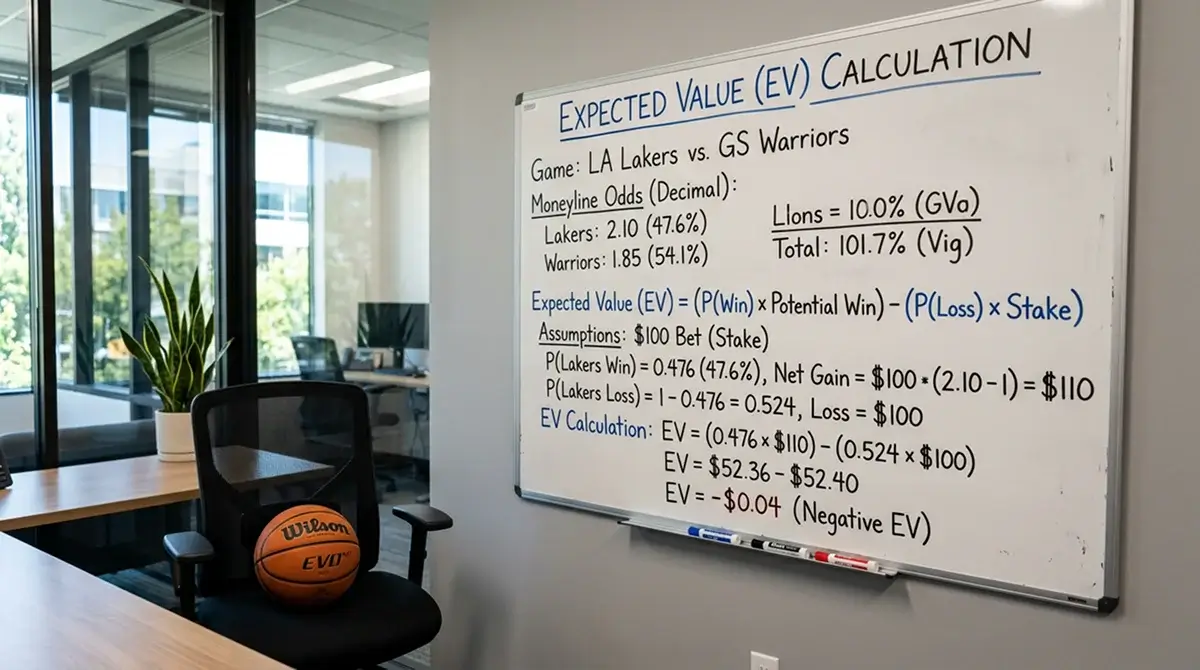
The overround is the mechanism that ensures the bookmaker profits regardless of the outcome. It works by pricing both sides of a market so that the implied probabilities sum to more than 100%. On a fair coin toss, each side would be priced at 2.00 (50% implied each, totalling 100%). In practice, the bookmaker prices each side at 1.91 (52.4% implied each, totalling 104.8%). That 4.8% surplus is the overround — the built-in margin that guarantees the operator a profit over time.
For NBA betting, the overround varies by market and operator. Main spreads and totals typically carry a 4% to 5% overround at competitive UK bookmakers. Player props run 6% to 10%. Exotic markets — first basket scorer, exact total points — can carry overrounds of 15% or more. The higher the overround, the larger the edge you need just to break even.
I check the overround on every market before placing a bet. The calculation is simple: convert each side’s decimal odds to an implied probability, add them together, and subtract 100%. If the sum is 104%, the overround is 4%. If it is 108%, the overround is 8%. The lower the overround, the less the bookmaker is taking from your potential profit — and the easier it is for your analytical edge to translate into actual returns.
One practical implication: the overround is the reason why expected value calculations are essential. A bet that looks profitable at face value — “I think this team wins 55% of the time and the odds are 1.91” — might not be profitable once the overround is accounted for. At 1.91, you need to win 52.4% of the time just to break even. Your 55% estimate gives you an edge of 2.6%, which is genuine but modest. If the overround were lower — say, odds of 1.95 — the breakeven drops to 51.3%, and your 55% estimate produces a larger edge. The odds format does not change; the overround does. And that difference, compounded across hundreds of bets, determines whether your season ends in profit or loss.
Why do UK bookmakers default to decimal odds for NBA?
Decimal odds are the European standard and the simplest format for quick calculation. UK bookmakers present all non-horse-racing sports in decimal by default because the single-multiplication payout calculation is more intuitive than fractional odds for most online bettors. You can switch to fractional or American format in your account settings at most platforms, but decimal is the most practical for NBA betting.
What is the typical overround on NBA match-winner markets?
At competitive UK bookmakers, the overround on NBA match-winner (moneyline) markets typically ranges from 4% to 6%. Less competitive operators may price at 6% to 8%. The overround tends to be lower on high-profile games that attract more volume and higher on midweek games between smaller-market teams. Checking the overround before betting helps you identify which operator is offering the best value on each specific game.
Prepared by the bet Tips nba editorial staff.