
NBA Lines Start Moving Hours Before Tip-Off — Learning to Read Them Is a Skill
 Available in US
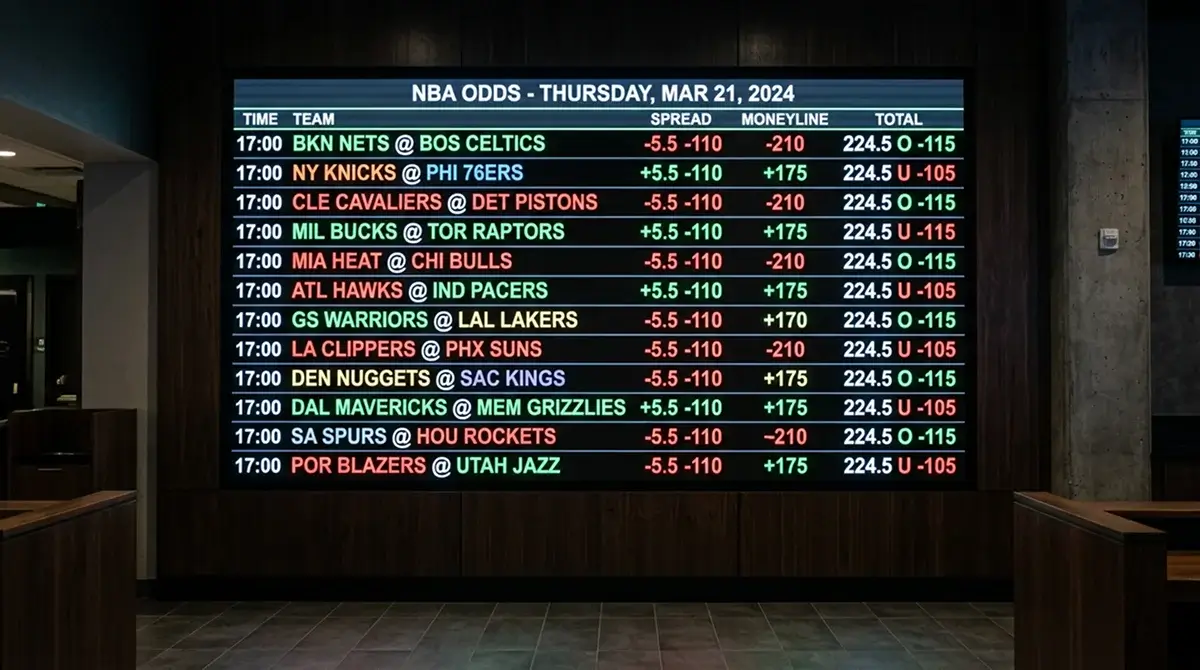
The first time I consciously tracked a line from open to close, I was stunned by how much happened. The Warriors-Clippers spread opened at Golden State -4.5 at 11:00 AM Eastern. By 1:00 PM it was -5.0. By 5:00 PM, after sharp action landed, it ticked to -5.5. Then at 6:30 PM, 30 minutes before tip, it dropped back to -5.0 after a questionable tag appeared on a Warriors starter. Four moves in eight hours, each telling a different story about who was betting, what they knew, and how the market was digesting information.
Online platforms handle roughly 95% of all wagers in legalised US states, and every one of those bets leaves a trace in the line. Reading those traces — understanding why a number moves, when to bet into the movement, and when to wait — is one of the most practical skills an NBA bettor can develop.
Opening vs Closing Lines: What the Gap Reveals
The opening line is the bookmaker’s first offer. It is set using models, historical data, and market-maker intuition, but it has not yet absorbed any public or sharp money. The closing line — the final number at tip-off — is the market’s best estimate of the true probability, refined by hours of betting activity from both sides. The gap between the two is pure information.
When the closing line moves significantly from the opener, the direction tells you which side attracted the strongest action. If the Celtics opened at -3.0 and closed at -4.5, the smart money moved toward Boston. If they opened at -3.0 and closed at -2.0, the sharp action favoured the opponent. That movement is not a prediction of who wins — it is a signal of where the most informed bettors put their money.
Over two full seasons, I tracked opening-to-closing line gaps for every NBA game and correlated them with ATS outcomes. The finding was clear: the closing line is a better predictor of the outcome than the opening line. Games where the line moved by 1.5 or more points in one direction saw the closing-line side cover at approximately 53% — a meaningful edge. This confirms what market-efficiency theory predicts: the more information the line absorbs, the more accurate it becomes.
The practical takeaway: if you are going to bet with the direction of line movement, you want to be early — placing your bet before the line moves, not after. Betting after the move means you are getting the closing-line side at a worse number than the people who drove the movement. That is paying more for the same information.
What Causes NBA Lines to Move: Injuries, Sharps, and Volume
Three forces drive line movement, and distinguishing between them is essential. The first is injury news. When a star player’s status changes — from probable to doubtful, from questionable to out — the line adjusts immediately. These moves are the easiest to identify because they coincide with publicly available injury report updates. The adjustment is usually proportional to the player’s value, ranging from one to five points for franchise players.
The second force is sharp money. FanDuel and DraftKings together hold around 75% of the regulated US market share, and both platforms are sensitive to professional-level action. When a syndicate or a respected sharp account places a large wager, the platform moves the line to manage liability — even if public sentiment is overwhelmingly on the other side. Sharp-driven moves are the hardest to identify in real time because they do not coincide with news events. The line simply moves without an obvious cause, which is the telltale sign.
The third force is volume. When the betting public heavily favours one side, the sheer weight of money can nudge the line — even without sharp action. Public-driven moves tend to be gradual (a half-point shift over several hours) rather than sudden (a full-point jump in minutes). They also tend to overcorrect, because the public overweights narratives and recent results. When I see a slow, steady drift in one direction without sharp-money confirmation, I treat it as a potential contrarian signal — the market is moving for emotional rather than analytical reasons.
When to Bet Early and When to Wait for the Close
The timing of your bet is as important as the bet itself. Bet too early and you risk taking a line that will move in your favour — meaning you could have gotten a better number by waiting. Bet too late and the value has already been captured by others.
My framework is simple. If my analysis is conviction-heavy and I believe the line will move against me (i.e., the market will eventually agree with my position and move the line in that direction), I bet early. Getting -3.5 before the line moves to -4.5 is capturing a full point of closing line value, which is pure profit over time.
If my analysis is moderate-conviction and I am unsure which direction the line will move, I wait. Specifically, I wait until the final injury report update — typically 60 to 90 minutes before tip-off — and then assess. By that point, the sharpest action has landed, the injury picture is clear, and the line is at its most informed. If my analysis still identifies value at the current number, I place the bet. If the movement has closed the gap between my projection and the line, I pass.
One pattern I have exploited consistently: betting against opening-line overreactions. Occasionally, a line opens at a number that feels too extreme — a seven-point spread that should be five, or a 230 total that should be 224. When I see an opening that diverges from my projection by three or more points, I take the opposite side immediately and trust that the market will correct. These correction bets — essentially betting that the line is wrong and will move toward my number — capture CLV at a high rate because the opening line has the widest margin of error.
The discipline is in the distinction. Early bets are for strong convictions where you expect the line to move against you. Late bets are for moderate convictions where you want maximum information before committing. Correction bets are for extreme openings where the line is detectably mispriced. Each timing strategy serves a different purpose, and mixing them up — betting early when you should wait, or waiting when you should act — erodes the edge that line-movement literacy provides.
For a deeper dive into the specific sharp-money signals that drive the most meaningful line shifts, the analysis in the sharp money indicator guide covers the handle-versus-ticket divergence and reverse line movement mechanics in detail.
Does line movement always mean sharp money is involved?
No. Lines move for three reasons: injury news, sharp money, and public volume. Injury-driven moves coincide with official report updates. Public-driven moves are gradual and follow the popular side. Sharp-driven moves are sudden, lack an obvious news catalyst, and sometimes go against the public consensus. Distinguishing between the three is essential for interpreting what the movement actually tells you.
How do I track NBA line movement at UK bookmakers in real time?
Most UK bookmakers do not display historical line movement on their platforms. However, several free US-based odds-tracking websites show opening and current lines across multiple sportsbooks, updated in near-real time. Since UK bookmakers derive their NBA pricing from US market movements, these tools are directly relevant. Checking the line two or three times between opening and tip-off captures the key movements.
Written by the editors at bet Tips nba.