The Public Bets with Emotion — and You Can Profit from It
 Available in US
The Public Bets with Emotion — and You Can Profit from It
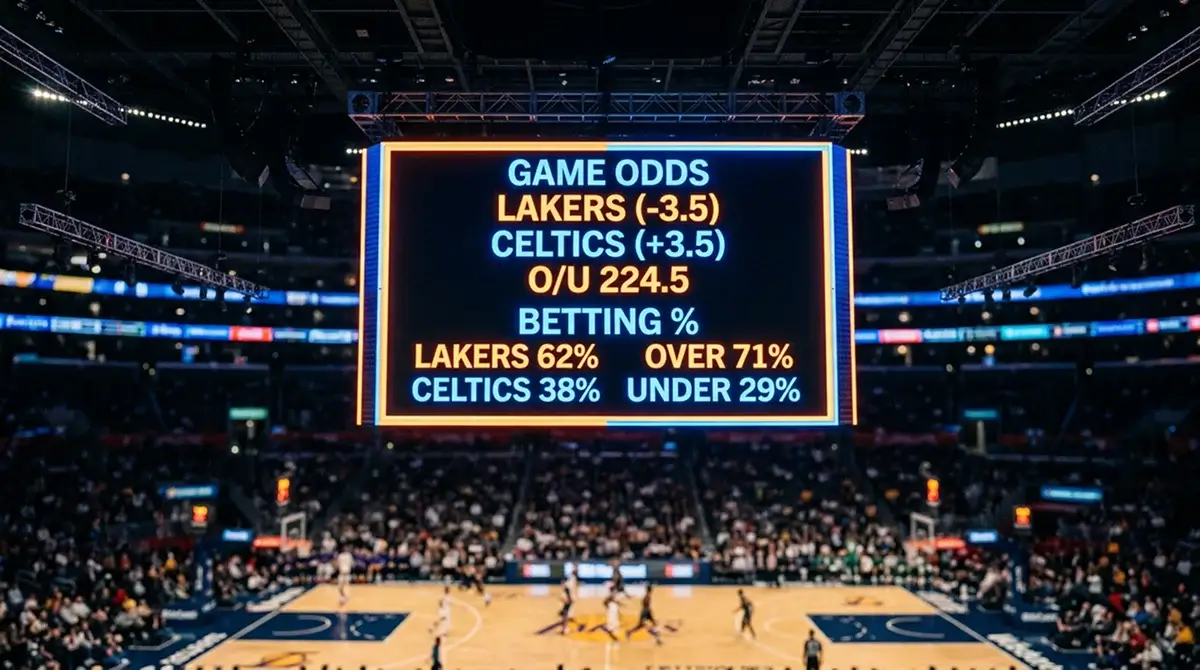
A few years back, I watched the Lakers close as -8.5 favourites against the Pelicans on a nationally televised Saturday night. The public betting split showed 81% of tickets on the Lakers. Eighty-one percent. The line had not moved a single half-point since opening, which told me that the sharp money was quietly absorbing all that public action on the other side. The Pelicans won outright by four. That game crystallised something I had been seeing in the data for months: the bigger the public consensus, the more interesting the other side becomes.
Over 52% of American sports bettors placed at least one basketball wager in the past year, making the NBA the most popular single betting sport in the US. All that recreational money — driven by fandom, narrative, and prime-time television — creates persistent biases. The public overvalues winning streaks, famous players, and nationally televised teams. Contrarian bettors who understand these patterns have a structural advantage that renews every single game night.
What Ticket and Handle Splits Actually Tell You
Two numbers drive every public-betting analysis: ticket percentage and handle percentage. Ticket percentage counts the number of individual bets on each side. Handle percentage measures the total money wagered on each side. When those two numbers diverge, information is leaking.
Consider a game where 75% of tickets are on Team A but only 58% of the handle. A lot of small bets are backing Team A — the public side. But the larger wagers — the ones from bettors who stake five or ten times the average — lean toward the opponent. The ticket-heavy public is betting with their gut. The handle-heavy minority is betting with their model. When the gap between ticket and handle exceeds 15 percentage points, I treat it as a yellow flag for the public side and a green flag for the contrarian play.
Not every divergence produces a winner, and I want to be clear about that. Public money wins regularly — the Lakers at -8.5 cover plenty of Saturday nights. What the divergence tells you is not who wins tonight but where the informed money disagrees with the crowd. Over hundreds of bets, that disagreement has a measurable edge. In my own database, games where ticket and handle diverge by 15-plus points and I took the contrarian side have hit at 53.8% against the spread — a sustainable edge on standard pricing.
When Fading the Public Works — and When It Does Not
Fading the public is not a magic button. It is a filter — one that works best in specific conditions and fails in others. Knowing the difference is the entire skill.
Fading works best when public sentiment is driven by narrative rather than substance. The team on a five-game winning streak that the media cannot stop talking about. The star player who just dropped 50 in the previous game. The marquee matchup that draws casual bettors who have not looked at a stat sheet. In these situations, the line often moves to accommodate the public weight rather than reflecting the true probability, which creates value on the other side.
Fading fails when the public consensus aligns with genuine market efficiency. If 78% of tickets and 74% of the handle are on the same side, there is no divergence — the public and the sharps agree. Fading that consensus is contrarianism for its own sake, which is a losing proposition. I also avoid fading the public in playoff games, where the increased scrutiny and reduced schedule mean that casual-bettor biases are smaller and the lines are sharper.
Around 10% of the UK population bets on sport online, and a meaningful portion of that betting volume tracks the same narrative biases that drive the American public. UK bookmakers derive their NBA lines from the US market, so when American public money pushes a line in one direction, UK bettors who recognise the distortion can exploit it at their own platforms — often with a slight time lag that extends the value window.
My rule: I only fade the public when my own analysis already leans toward the contrarian side and the public data confirms the opportunity. The public split is a confirmation tool, not a decision tool. If I cannot find independent analytical reasons to support the contrarian play, I do not take it just because the public percentage is high. Blindly fading every heavily-backed team produces a hit rate around 50.5% to 51% — barely above break-even and not enough to cover the vig consistently.
Free Sources for NBA Consensus Data
Several US-based websites publish daily NBA consensus data at no cost. The data typically includes ticket percentages and, in some cases, estimated handle splits for every game on the slate. The granularity varies — some sites update every 30 minutes, others show a single snapshot closer to tip-off — but even a once-daily check provides enough information to identify the heaviest public leans.
For UK bettors, the timing of data availability is fortunate. US consensus data typically solidifies by early evening UK time, which gives you several hours to review the splits, compare them against your own analysis, and place bets before the lines move further. I check consensus data once per day, around 6:00 PM GMT, as part of a 15-minute pre-match review alongside injury reports and sharp money indicators.
A word of caution on data quality: free consensus sites estimate ticket percentages using data from a limited number of sportsbooks, not the entire market. The estimates are directionally correct — if they show 78% of tickets on one side, the true figure is unlikely to be 55% — but the precision can be off by five to ten percentage points. Treat the numbers as ballpark indicators rather than exact measurements. The directional lean matters; the second decimal place does not.
Some bettors pay for premium consensus services that aggregate data across more platforms and provide real-time updates. In my experience, the free data is sufficient for pre-match analysis. The premium advantage is speed — seeing the handle split shift in real time during the hours before tip-off — which matters more for live bettors than for pre-match players. If your NBA betting approach is built around identifying contrarian value before the games start, the free tools do the job.
What percentage of the public needs to be on one side before I consider fading?
A useful threshold is 70% or higher on ticket percentage with a meaningful divergence from handle percentage. Below 70%, the public lean is too mild to create a reliable contrarian edge. Above 75%, and especially above 80%, the narrative-driven bias is usually strong enough that the other side offers value — provided your independent analysis supports the contrarian play.
Is public betting data reliable for NBA games at UK bookmakers?
The publicly available consensus data comes from US sportsbooks, not UK platforms. However, because UK bookmakers derive their NBA pricing from US market movements, the public biases captured in US data directly influence the lines you see at your UK bookmaker. The directional information is reliable for UK betting decisions, even though the exact ticket counts do not reflect UK-specific betting volume.
Published by the bet Tips nba team.