Professional NBA Betting Strategy and EV Analytics
 Available in US

In 2019, I went through a stretch where I won 61 per cent of my NBA bets over six weeks and thought I’d figured the game out. Then I lost money the next three months despite maintaining a 53 per cent hit rate. The difference was that my winning streak came on a run of short favourites — bets paying 1.65 to 1.80 — while my 53 per cent stretch came on longer prices where each loss wiped out more than one win. Win rate doesn’t tell you whether you’re profitable. Expected value does. That realisation was the dividing line between being a gambler and being a bettor with a strategy. A core component of any profitable system is understanding how to apply NBA expected value betting principles to every single wager.
The US legal sports betting market processed $166.94 billion in wagers during 2025, with bookmaker revenue reaching a record $16.96 billion — a 22.8 per cent year-on-year increase. The market is liquid, competitive, and increasingly efficient. The days when a casual bettor could pick winners by gut feel and make money are over, if they ever existed. What works now is a system: a repeatable process for identifying value, managing risk, and reviewing performance honestly over time.
This guide builds that system from scratch. I’ll walk through expected value as a decision framework, closing line value as the metric that actually proves whether you have an edge, the advanced metrics that drive my own NBA model, the situational edges built into the league’s schedule, and how all of it shifts between the regular season and playoffs. Nothing here requires a maths degree. It does require discipline and the willingness to track your bets with the same seriousness a business tracks revenue.
- Creating an Expected-Value Framework for UK Bookmakers
- Closing Line Value: The Only Metric That Proves You Have an Edge
- Applying ORTG, DRTG, and Net Rating to Your Model
- Situational Edges: Rest, Travel, and Scheduling Mismatches
- How Strategy Shifts Across the NBA Season
- Tracking Your Bets: Spreadsheets, Tools, and Honest Review
- Frequently Asked Questions
Creating an Expected-Value Framework for UK Bookmakers
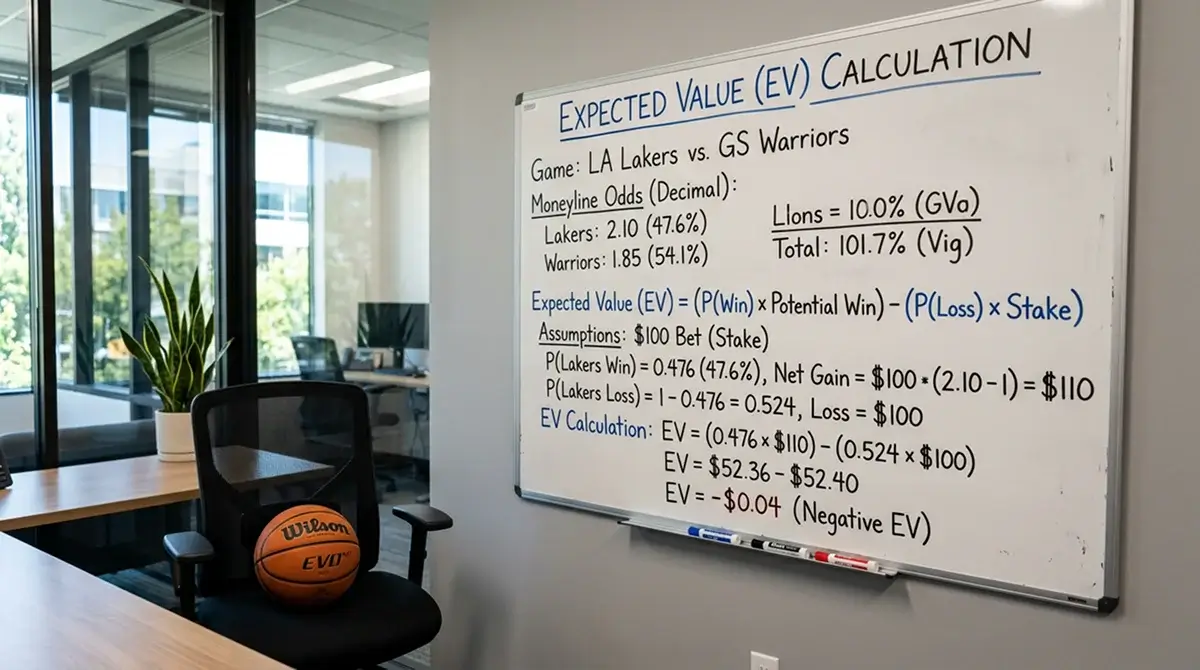
Expected value is the average amount you win or lose per bet if you placed the same bet thousands of times. Positive EV means the bet is profitable over the long run; negative EV means it’s a slow drain on your bankroll. Every bet you place has an expected value, whether you calculate it or not. The difference between recreational bettors and serious ones is that serious bettors calculate it before clicking “place bet.”
The formula itself is simple. EV equals (probability of winning multiplied by the profit if you win) minus (probability of losing multiplied by the stake you lose). Suppose you believe the Celtics have a 58 per cent chance of covering a spread priced at 1.91 in decimal odds. Your potential profit on a GBP 10 bet is GBP 9.10. Your EV is (0.58 times 9.10) minus (0.42 times 10) = 5.28 minus 4.20 = +1.08. That’s GBP 1.08 of positive expected value per bet — roughly an 11 per cent edge.
The hard part isn’t the formula. It’s the input: your estimate of the true probability. Where does that number come from? It comes from your model — your systematic process for evaluating a game. That model might be a spreadsheet that weights ATS records, rest days, pace mismatch, and defensive ratings. It might be a statistical regression. It might be a structured checklist you work through before every game. The form doesn’t matter. What matters is that you have a defined, repeatable process for arriving at a probability estimate, and that you trust it more than your feelings about who “should” win.
I spent my first three seasons eyeballing probabilities — “I think the Bucks cover about 55 per cent of the time in this spot.” That’s not a model. That’s a guess dressed up in numbers. The turning point was when I built a simple regression model using five variables: home/away, rest differential, net rating differential, pace differential, and the closing spread from the previous matchup between the two teams. It wasn’t sophisticated, but it was systematic, and it forced me to assign probabilities based on data rather than narrative.
For a deeper walkthrough of EV calculation including worked examples with UK decimal odds and tips for identifying positive-EV spots, see the expected value betting guide I’ve written as a companion to this page.
One critical point: you don’t need to win most of your bets to be profitable. At typical spread odds of 1.91, you need a 52.4 per cent win rate to break even. A bettor who wins 54 per cent of spread bets at 1.91 is making roughly 3 per cent ROI — which sounds tiny but compounds into serious money over hundreds of bets. The goal of an EV framework is not to pick big winners. It’s to make hundreds of small, positive-EV decisions that compound over time.
Closing Line Value: The Only Metric That Proves You Have an Edge
Last season, a friend of mine hit 57 per cent of his NBA spread bets and was convinced he was a sharp bettor. I asked him one question: were you beating the closing line? He didn’t know what I meant. When we went back through his records, it turned out he was consistently betting lines that moved against him by tip-off — taking teams at -5 that closed at -4, or +3 that closed at +4. His 57 per cent win rate was a statistical blip. The closing line movement told a different story: the market thought his bets were wrong, and over a longer sample, the market would be right.
Closing line value, or CLV, measures whether the odds you got were better than the odds available at tip-off. If you bet the Nuggets at -3.5 and the line closes at -4.5, you got a full point of CLV — the market moved in the direction of your bet, confirming that the smart money agreed with your position. If you bet the Nuggets at -3.5 and the line closes at -2.5, you got negative CLV — the market moved against you.
Why does this matter more than win rate? Because the closing line is the most efficient price the market produces. It incorporates all available information: public money, sharp money, injury news, and algorithmic models from every major bookmaker. In the US alone, FanDuel and DraftKings control roughly 75 per cent of the regulated handle between them — and the closing line at these dominant platforms reflects an enormous volume of informed opinion. Consistently getting better prices than the closing line is the strongest evidence that you’re identifying value the market hasn’t fully priced. Win rate over 200 bets can be driven by variance. CLV over 200 bets is signal.
I track CLV on every bet I place. At the end of each month, I calculate my average CLV in points (for spread bets) and in percentage terms (for moneyline and totals). A positive average CLV across a full NBA season tells me my process is working even during losing stretches. A negative average CLV tells me I need to rethink my approach — even if I happen to be winning, because negative CLV catches up with you eventually.
Practically, beating the closing line means betting early when your analysis identifies a mispriced line, and betting at the bookmaker offering the best available number. If your model says the Celtics should be -5 and the opening line is -3.5, that’s two points of theoretical edge. By the time the market corrects to -5, you’ve locked in your price. This requires accounts at multiple UK bookmakers — three at minimum, five ideally — and the discipline to place your bet when the line is right rather than waiting until game night when the line has already moved.
Applying ORTG, DRTG, and Net Rating to Your Model
A mate who’s been betting football for twenty years once asked me what NBA metrics I use. I said “offensive rating, defensive rating, and Net Rating” and his eyes glazed over. So let me explain it the way I wish someone had explained it to me when I started: these three numbers tell you how many points a team scores per 100 possessions, how many they allow per 100 possessions, and the difference between the two. That’s it. Everything else in basketball analytics flows from these three concepts.
Offensive Rating — ORTG — measures efficiency: points scored per 100 possessions. A team with an ORTG of 115 is scoring 115 points every time it has 100 possessions. The league average is typically around 112-114. Defensive Rating — DRTG — is the mirror: points allowed per 100 possessions. Lower is better. A DRTG of 108 means the team is allowing 108 points per 100 possessions. Net Rating is the difference: ORTG minus DRTG. A team with a +7 net rating is outscoring opponents by 7 points per 100 possessions, which is elite.
Why per-100-possessions and not per game? Because pace varies enormously across the NBA. A team that plays at the league’s fastest pace might have 105 possessions per game; a slow team might have 95. Comparing raw points per game between these two teams is misleading because the fast team has more chances to score. Per-100-possessions normalises for pace and gives you a clean comparison of how efficient each team actually is.
In the 2025-26 season, with more than 1.3 billion hours of NBA content consumed on linear and streaming platforms, the amount of publicly available data on ORTG, DRTG, and Net Rating is staggering. Every serious statistical site publishes these numbers updated daily. The edge isn’t in accessing the data — it’s in applying it to betting. Here’s how I do it.
For spread bets, I project the game total by averaging the ORTG of each team against the DRTG of their opponent, adjusting for pace. Then I project the margin by comparing the net ratings, adjusting for home-court advantage. If my projected margin is -5.2 and the bookmaker’s spread is -3, that’s a potential edge. I don’t bet every game where my model disagrees with the line — I bet games where the disagreement exceeds a threshold (typically 2+ points) and where I’ve identified a specific factor the model might be capturing that the market hasn’t.
Recent performance matters more than season-long averages. A team’s ORTG over the last 15 games is more predictive of their next game’s performance than their full-season ORTG, because it captures lineup changes, injuries, and tactical evolution. I use a weighted average: 60 per cent weight on the last 15 games, 40 per cent on the full season. Early in the season (first 20 games), I lean more heavily on last season’s data because the in-season sample is too small.
Situational Edges: Rest, Travel, and Scheduling Mismatches
The NBA plays 82 games in roughly 170 days, which means teams are playing every other day on average — with significant variation. Some stretches pack four games into five nights. Others include multiple back-to-backs with cross-country flights in between. This uneven schedule creates predictable performance differentials that the betting market doesn’t always fully price.
The clearest edge is the rest mismatch: one team on two days’ rest facing another team on the second night of a back-to-back. The rested team has a historical ATS advantage that varies by season but typically sits around 53 to 55 per cent. It’s not a massive edge, but it’s consistent and well-documented. In the 2025-26 season — the most-watched NBA season in 24 years, with 170 million US viewers — the league’s expanded media schedule created more rest mismatches than ever, particularly in the back half of the season as teams jockeyed for playoff positioning.
Travel is the less obvious factor. A team flying from Miami to Portland (cross-country, three time zones) for a game the next night is dealing with fatigue, jet lag, and disrupted routines. The market accounts for this to some degree, but I’ve found that multi-leg road trips — a team playing in Denver, then flying to Portland, then to Sacramento in five nights — produce a cumulative fatigue effect that gets more pronounced with each game. The first road game of the trip covers at roughly league-average rates. By the third or fourth game, the covering rate drops measurably.
Altitude is a specific wrinkle that many bettors overlook. Denver plays at 5,280 feet. Visiting teams, especially those coming from sea-level cities, report noticeably higher fatigue in the second half of games in Denver. This is reflected in the Nuggets’ historically strong ATS record at home, particularly in the second half. I track second-half spreads separately for Denver home games and have found consistent value on the Nuggets’ second-half line, especially against teams that travelled to Denver from out of the Mountain time zone.
One scheduling quirk that applies specifically to UK bettors: Monday night NBA slates are often thin — three or four games — which means less public money and potentially softer lines. I’ve had my best CLV results on Monday and Tuesday nights when the casual betting volume is lower and the lines are set more by the bookmaker’s model than by the weight of public money.
How Strategy Shifts Across the NBA Season
Betting the NBA the same way in October as you do in April is like wearing the same clothes in summer and winter — technically possible, but you’ll be uncomfortable and the results will show it. The NBA season has distinct phases, and each one demands a different strategic emphasis.
The first three weeks of the season are chaos. Rosters are new, rotations are unsettled, and the statistical profiles of teams haven’t stabilised. I reduce my volume during this stretch — betting maybe 20 per cent of what I’ll bet in December — because the data inputs to my model are unreliable. What I do during early October is build a watchlist: teams whose early-season performance looks meaningfully different from their projected strength, either positively or negatively. By mid-November, when rotations have settled and I have 15+ games of data, those watchlist teams become my primary targets.
December through February is the core of the season and where I place the most bets. The data is robust, the schedule produces regular rest and travel mismatches, and the market has enough liquidity to keep lines competitive. This is also when fatigue starts to differentiate good teams from great ones — a team with depth handles the mid-season grind better than a top-heavy roster, and the ATS records often diverge accordingly.
March through mid-April is the stretch run, and two competing forces reshape the market. Contending teams ramp up intensity as playoff positioning matters; lottery teams tank by resting veterans and giving minutes to developmental players. The tanking dynamic is the more exploitable of the two. When a team with a losing record shuts down its best player “for rest” three times in two weeks, the market adjusts the spread — but not always by enough. I’ve found value on the opposing side in these situations, particularly when the tanking team’s line doesn’t fully account for the drop in quality.
The playoffs are a different sport. The sample resets. Regular-season ATS trends lose most of their predictive power because the intensity, preparation, and rotation tightness change so dramatically. I cut my unit size in half for playoff bets because the variance is higher and the market is sharper — every sharp bettor in the world is focused on the same 16 teams. The edge in playoff betting comes from series-level analysis (how a specific matchup evolves from Game 1 to Game 4) rather than from broad situational patterns.
Tracking Your Bets: Spreadsheets, Tools, and Honest Review
Adam Silver has spoken publicly about the growing complexity of the betting landscape, expressing concern about “all the different activity that’s happening out there.” His worry is about integrity, but the same complexity that concerns the commissioner also challenges individual bettors. Without rigorous tracking, you can’t distinguish luck from skill, and you can’t identify the specific situations where your process works and where it breaks down.
My tracking spreadsheet has evolved over nine years, but the core columns have stayed the same: date, teams, market (spread/total/moneyline/prop), my line at bet placement, the closing line, my probability estimate, the bookmaker’s implied probability, the stake, the odds, the result, and the profit/loss. From these fields, I calculate CLV, ROI by market type, ROI by situation (home favourite, road underdog, rest advantage, etc.), and hit rate by confidence tier.
The most valuable column is the one most bettors don’t track: the closing line. Without it, you can’t calculate CLV, and without CLV, you have no way to assess whether your process has a genuine edge or whether your results are driven by variance. I pull closing lines from free odds-comparison sites — it takes two minutes per game the morning after.
Monthly reviews are non-negotiable. At the end of every month during the NBA season, I sit down with my spreadsheet and ask five questions. Am I beating the closing line on average? Which market types are producing positive ROI and which are dragging? Which situational filters are working and which have decayed? Is my staking discipline holding — am I keeping to my unit sizes and not chasing losses? And finally, is there a new variable I should add to my model based on what I’ve observed this month?
Honesty is the hardest part. The human brain is wired to explain away losses and take credit for wins. Your spreadsheet doesn’t have that bias. If the numbers say your prop betting is a net negative, the correct response is to stop betting props or overhaul your prop process — not to remember the three times you crushed it and forget the fifteen times you didn’t. The spreadsheet is the mirror. Look at it honestly, and your strategy gets better. Look away, and you’re just a gambler with a spreadsheet. Discover more data-driven insights and expert predictions on the Courtside homepage to refine your approach.
Frequently Asked Questions
How many bets do I need to track before judging my NBA strategy?
A minimum of 300 spread bets across at least two months of the season gives you enough data to assess your hit rate and CLV with reasonable confidence. Fewer than 200 bets and your results are dominated by variance — a 56 per cent hit rate over 100 bets is statistically indistinguishable from a 50 per cent true rate. For prop bets, the threshold is even higher because the variance per bet is greater. Track from the start, but delay judgement until the sample is meaningful.
What is a realistic long-term ROI for NBA betting?
A strong NBA bettor can sustain 2 to 5 per cent ROI on spread bets over a full season. That translates to roughly GBP 2 to GBP 5 profit per GBP 100 wagered. It sounds modest, but over 500 bets at GBP 50 per bet, a 3 per cent ROI is GBP 750 in profit. Anything consistently above 5 per cent is elite-level performance. Claims of 10 or 15 per cent long-term ROI on spreads should be treated with extreme scepticism.
How do I adjust my strategy for the NBA playoffs versus the regular season?
Reduce your volume and unit size. Playoff markets attract heavier sharp action, which makes the lines more efficient. Regular-season situational edges like rest mismatches and schedule fatigue largely disappear because playoff teams have two to three days between games. Focus your analysis on the specific series matchup — how a particular offensive system interacts with a particular defensive scheme — rather than on broad statistical patterns. Re-evaluate after each game in a series as adjustments accumulate.
Published by the bet Tips nba team.