UK NBA Handicap and Point Spread Betting Models
 Available in US

Early in my career, I spent an embarrassing amount of time confused by a bet that had already settled in my favour. A US-based model flagged Celtics -4.5 as a value play. I opened my UK bookmaker, found “Boston Celtics -4.5” listed under the handicap market at 1.91, placed the bet — and then panicked when I could not find a matching “spread” tab anywhere on the site. The tab did not exist because the handicap market was the spread. Same wager, different label.
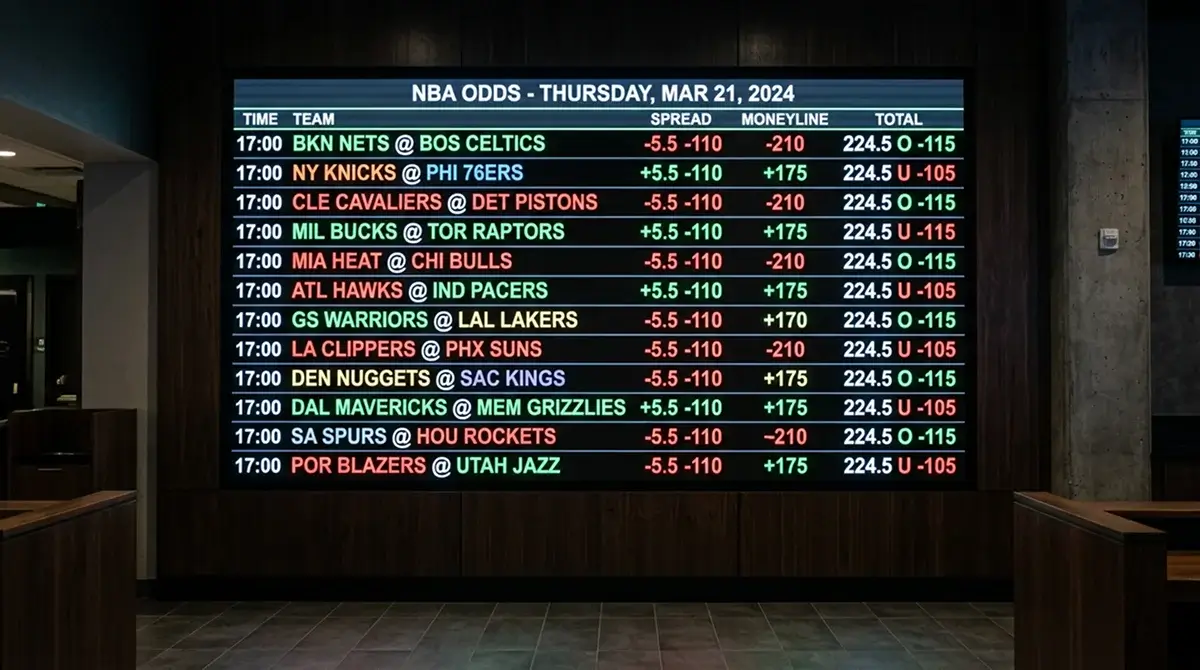
Basketball occupies somewhere between 15% and 18% of global betting turnover, and the overwhelming majority of that volume flows through spread-style markets. In the US, they call it the point spread. In the UK, it is listed as a handicap. The underlying mechanics are identical: one team receives a points advantage or disadvantage, and the bet settles on the adjusted final score. The only things that change are the odds format, the naming convention, and a couple of edge-case rules around push outcomes.
If you have ever read American NBA analysis and felt like you were decoding a second language, this article bridges the gap. By the end, you will move between US spread talk and UK handicap lines without a moment of hesitation.
Mechanics of NBA Handicap Lines at UK Bookmakers
Let me walk you through a real-world scenario. The Golden State Warriors are hosting the Miami Heat. The Warriors are favoured, so the UK bookmaker lists them at a handicap of -6.5 and the Heat at +6.5. If you back the Warriors -6.5, they need to win by seven or more points for your bet to land. Back the Heat +6.5, and Miami can lose by up to six points and you still collect.
The odds attached to each side are displayed in decimal format — say, Warriors -6.5 at 1.91 and Heat +6.5 at 1.91. That 1.91 on both sides is the UK equivalent of the American -110 standard. It means the bookmaker is taking roughly a 4.5% margin (the overround) on the market. A ten-pound bet at 1.91 returns 19.10 pounds if it wins — a profit of 9.10 pounds.
The half-point matters enormously. Lines ending in .5 eliminate the possibility of a push — a scenario where the margin of victory lands exactly on the number. When you see Warriors -6.0 (a whole number), the bet is void and your stake returned if the Warriors win by precisely six. Most UK bookmakers handle pushes this way, though some platforms offer “dead heat” rules on certain markets. Always check the specific terms.
One structural note: UK handicap markets occasionally list a “European handicap” option, which works differently. European handicaps have three outcomes — home win, draw, away win — after the handicap is applied. For NBA betting, you almost always want the standard (Asian-style) two-way handicap, which mirrors the American point spread exactly. If you see three possible outcomes on a basketball handicap, you are looking at the wrong market.
Alternative Handicaps and When to Use Them
Beyond the main line, every decent NBA spread market offers alternative handicaps — a ladder of lines ranging from -1.5 all the way to -15.5 or beyond. The further you move from the main line, the more the odds shift.
Here is how I use them. Say the main handicap is Warriors -6.5 at 1.91. I think Golden State wins comfortably — their opponent is on the second night of a back-to-back, missing a starting guard, and facing a hostile road crowd. I might take Warriors -8.5 at 2.15 for a better payout, accepting the tighter margin. Alternatively, if I like Golden State but want more insurance, I could take Warriors -3.5 at 1.60 — lower odds, but a cushion of three extra points.
Alternative handicaps are not magic. They are a tool for expressing conviction. If your analysis says a team wins by double digits, the main line at -6.5 is leaving value unclaimed. If your read is less certain, buying a cheaper line at -3.5 reduces variance. The key is that your handicap selection should follow from your projected margin of victory, not from a desire for better odds. Chasing longer prices on alternative lines without a corresponding analytical reason is a reliable way to bleed money.
One practical application I lean on during the regular season: when a star player is ruled out late and the main handicap has already adjusted, alternative lines sometimes lag behind. The main might shift from -6.5 to -3.5 within minutes, but the -1.5 alternative can briefly sit at odds that reflect the old projection. Those windows close fast, but they exist — particularly at bookmakers that price alternatives from a model rather than updating them manually.
Converting American Spreads to Decimal Handicap Odds
If you follow any US-based NBA analysis — and you should, because that is where the deepest coverage lives — you will encounter American odds constantly. The conversion is mechanical once you have done it a few times.
American odds come in two flavours. Negative numbers (like -110) tell you how much you need to stake to win 100 units. Positive numbers (like +150) tell you how much you win on a 100-unit stake. To convert to decimal: for negative American odds, divide 100 by the absolute value of the number, then add 1. So -110 becomes (100 / 110) + 1 = 1.909, which rounds to 1.91. For positive odds, divide the number by 100, then add 1. So +150 becomes (150 / 100) + 1 = 2.50.
The UK betting market generates roughly 2.48 billion pounds in annual gross gaming yield, and the vast majority of that is settled in decimal odds. You do not need to memorise conversion formulas — your bookmaker handles the display — but understanding the maths lets you cross-reference American tipster recommendations against your own platform instantly.
Here is a quick reference that covers the most common NBA spread odds:
American -110 equals decimal 1.91. American -105 equals decimal 1.95. American +100 equals decimal 2.00. American +110 equals decimal 2.10. American -120 equals decimal 1.83. These five conversions cover probably 80% of the NBA spread prices you will encounter. Pin them somewhere visible until they become automatic.
The handicap number itself — the -6.5 or +3.5 — does not change between formats. A team that is -4.5 on an American sportsbook is -4.5 at your UK bookmaker. Only the odds attached to that line differ in presentation. This is worth repeating because it is the single most common source of confusion: the spread is the spread. The odds format is just a wrapper.
What happens if the NBA handicap result is exactly on the line?
If the handicap is a whole number (e.g. -6.0) and the favoured team wins by exactly that margin, the bet is typically voided and your stake returned. This is called a push. Half-point handicaps (-6.5) eliminate this scenario entirely, which is why most NBA handicap lines use half-points.
Are alternative handicap odds better value than the main line?
Not inherently. Alternative handicaps offer different risk-reward profiles, but the bookmaker adjusts odds accordingly. They become valuable when your analysis projects a specific margin of victory that diverges from the main line — essentially, when you have a stronger opinion than the market on how much a team will win or lose by.
Prepared by the bet Tips nba editorial staff.