NBA In-Play Live Betting Strategy 2026
 Available in US
I remember watching a Nuggets-Lakers game in 2023 where the Lakers opened the third quarter on a 14-2 run, and the live spread flipped from Denver -8 to Lakers -1.5 within four minutes of game time. By the end of the quarter, Denver had clawed back the lead and the live spread was back to Denver -6. If you’d bet Denver at +1.5 during that Laker run, you’d have captured seven points of value in a game the Nuggets eventually won by nine. That kind of swing — dramatic, fast, and exploitable — is what makes live NBA betting the most dynamic market in sports. In-play momentum shifts are highly predictable if you follow our NBA quarter betting tips to target specific periods of the game.
In-play betting now represents 62.35 per cent of the US online sports betting market, and it’s projected to grow at nearly 14 per cent annually through 2031. Micro-betting — wagering on the next possession, the next basket, the next free throw — has exploded by 214 per cent year-on-year and now makes up 38 per cent of all in-play action on major platforms. The NBA’s own product innovation tells you where the league thinks the money is heading: they’ve introduced a $1.99 streaming option for the final quarter of games, explicitly designed for in-game bettors who want to watch and wager simultaneously.
For UK punters, live NBA betting comes with a timing challenge — most games tip off between 11 p.m. and 3:30 a.m. GMT. But that late-night window is also an advantage. Fewer UK bettors are active, which can mean softer live lines at UK bookmakers compared to the razor-sharp prices on American platforms during prime-time US hours. This guide covers how live odds update, where momentum shifts create value, how to bet quarters and halves, and how to stay disciplined when the pace of in-play wagering tries to separate you from your process.
- Mechanics of Real-Time NBA Live Odds Updates
- Spotting Momentum Shifts: Runs, Timeouts, and Foul Trouble
- Quarter and Half Betting: Isolating Segments
- Micro-Betting: Next Basket, Next Free Throw, Next Turnover
- UK Platforms with the Best NBA Live Betting Coverage
- Staying Disciplined During a Live NBA Session
- Frequently Asked Questions
Mechanics of Real-Time NBA Live Odds Updates
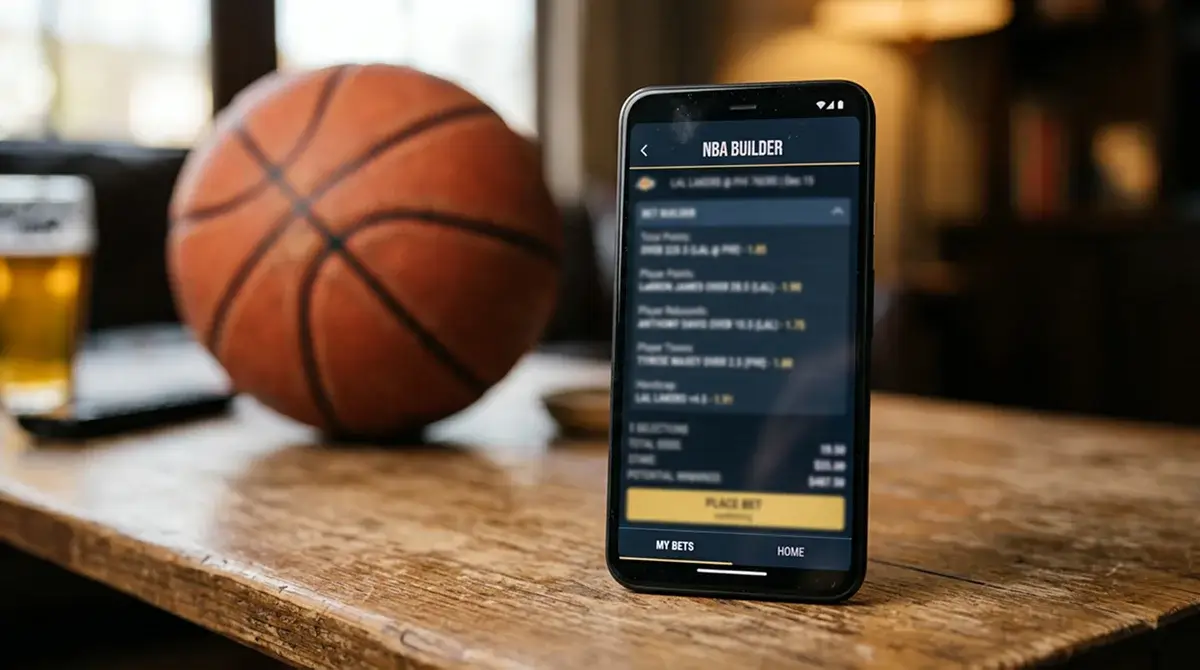
The first time I bet a live NBA market, I clicked on a line and by the time I confirmed the bet, the odds had changed. That three-second delay wasn’t a glitch — it’s the fundamental reality of live betting. NBA live odds are recalculated after every meaningful event: a made basket, a foul, a timeout, a substitution, a turnover. The algorithms that drive live pricing process these events in fractions of a second, adjusting the spread, the moneyline, and the totals in response to the shifting probability landscape.
NBA League Pass and other streaming partnerships mean the bookmaker’s data feed often runs a few seconds ahead of what you’re watching on television or a UK stream. This latency gap matters. If you’re watching a game on a standard broadcast and you see a three-pointer go in, the live odds at your bookmaker have likely already adjusted. Professional live bettors minimise latency by using data feeds or the fastest available streams, but for a UK bettor watching via a standard Sky Sports or League Pass broadcast, accept that you’re operating with a slight delay and adjust your approach accordingly.
NBA has allowed its authorised operators to stream the last quarter for just $1.99 — a product tailor-made for live bettors. The convergence of streaming and wagering is the clearest signal of where the industry is heading. For practical purposes, what this means for you is that the live betting markets are deeper, more liquid, and more competitively priced than they were even two seasons ago. The bookmaker can afford tighter margins on live bets because the volume justifies it.
The key mechanical concept to understand is that live spreads are not projections of the final margin — they’re real-time adjustments that factor in the current score, the time remaining, and the pre-game assessment of each team’s strength. A team that was a 3-point pre-game favourite and is trailing by 6 at half-time might be listed as a +2 or +3 live underdog. The bookmaker isn’t saying that team will lose — it’s saying that from this point forward, the probability distribution has shifted. Your edge comes from recognising when the shift has been too dramatic or too sluggish relative to what’s actually happening on the court.
Spotting Momentum Shifts: Runs, Timeouts, and Foul Trouble
Every NBA game contains three to five significant momentum shifts — stretches where one team goes on a 10-0 or 12-2 run that reshapes the complexion of the game. The live market reacts to these runs aggressively, and it often overreacts. That overreaction is your opportunity.
When a team goes on a big run, the live spread jumps in their favour. But here’s what nine years of tracking these situations has taught me: runs in basketball are partly real (a team’s defensive intensity rises, or a player gets hot) and partly noise (the other team missed three open looks in a row). The market prices the run as if it’s entirely signal, especially in the moment. A 10-0 run doesn’t mean the team that’s surging is 10 points better than the pre-game spread suggested. It usually means they had a four-minute stretch of above-average play that won’t sustain at that level.
Timeouts are the inflection points. When a coach calls a timeout to stop a run, the timeout itself often does stop it — not because of the tactical adjustment, but because the other team’s adrenaline fades and the trailing team resets mentally. I’ve found that betting against the run immediately after a timeout — taking the side that just got blitzed — produces value more often than not, particularly when the pre-game spread suggested the trailing team was legitimately competitive.
Foul trouble is another live-betting catalyst the market routinely misprices. When a team’s best player picks up his third foul in the first half and heads to the bench, the live spread moves against his team. The adjustment is typically 2 to 3 points. But the actual impact of a star sitting with foul trouble is more nuanced: he’ll be back in the second half, he’ll still play 28-32 minutes, and the team often plays a slower, more controlled style without him that keeps the game closer than the live line suggests. Foul trouble creates panic-driven live spreads, and panic-driven prices are where value lives.
The one momentum factor I’ve learned to respect is the third quarter. NBA teams make halftime adjustments, and some coaches — historically Erik Spoelstra, Steve Kerr, and the Boston coaching staff — are exceptional at it. When a team that trailed at half-time comes out with a completely different defensive scheme in the third quarter, the adjustment is real and persistent. I treat third-quarter surges from well-coached teams differently from first-half runs by anyone, because the tactical underpinning gives them staying power.
Substitution patterns also create live value that most bettors overlook. When a coach brings in a defensive-specialist lineup to close a quarter, the pace of the game drops and scoring slows — but the live total might not adjust quickly enough. Conversely, when two teams go to their bench units simultaneously, the quality of play drops and the variance increases, which often favours the over on the current quarter total because bench lineups play at a faster, sloppier pace. These are micro-patterns within the game’s momentum that won’t show up on a scoreboard but do show up in the live lines if you know where to look.
Quarter and Half Betting: Isolating Segments
Full-game betting asks you to be right about 48 minutes of basketball. Quarter and half betting asks you to be right about 12 or 24. That smaller window reduces the number of variables you need to account for, and in certain situations, it provides a cleaner read on predictable team tendencies.
First-quarter betting is the market where pre-game preparation pays off most directly. Some teams start games slowly — they play conservative offence, rotate through their bench early, and don’t fully engage defensively until the second quarter. Others come out firing from the opening tip with aggressive defensive pressure and fast-break offence. These tendencies are remarkably sticky across a season because they’re driven by coaching philosophy rather than individual player performance. Identifying teams with a pattern of strong or weak first quarters, then comparing that pattern against the first-quarter spread the bookmaker has set, produces a surprisingly stable edge.
Half-time betting offers a different angle. At half-time, you have 24 minutes of data — real data from this specific game, not projections. The half-time line reflects the current score plus the bookmaker’s updated estimate of each team’s second-half strength. Where I’ve found value is in teams with a documented history of strong second halves, particularly teams that make significant tactical adjustments at half-time. The quarter betting guide I’ve put together covers the specific team-level patterns in more detail, but the core concept is the same: segment the game, find a team tendency the full-game line doesn’t capture, and bet the segment where that tendency is most concentrated.
A practical consideration for UK punters: quarter and half markets often have wider margins than full-game lines because the betting volume is lower. The overround on a first-quarter spread might be 6 to 7 per cent versus 4 to 5 per cent on the full game. That wider margin means your edge needs to be bigger to overcome the vig. I only bet quarters and halves when my analysis identifies a clear, data-backed tendency — not when I’m guessing. The margin for error on a 12-minute market is thinner than you’d think.
Micro-Betting: Next Basket, Next Free Throw, Next Turnover
Micro-betting is the frontier of NBA wagering. The premise is granular: instead of betting on who wins the game or even the quarter, you’re betting on what happens on the next possession. Will the next shot be a two or a three? Will the next free throw go in? Will the next possession result in a turnover?
I mentioned the growth numbers in the introduction, and they bear repeating in context: more than a third of all in-play wagers on major platforms now fall into the micro-betting category. The appeal is the instant gratification loop — bet, result, bet, result, repeat. Every 24 seconds of game time is a new market. For the bookmaker, micro-betting is enormously profitable because the margins on individual-possession markets are significantly higher than on full-game or even quarter markets, typically 8 to 15 per cent overround. For the bettor, the maths is brutal. You’re paying a steep tax on every wager, and the volume of bets amplifies the margin’s bite.
I treat micro-betting as entertainment, not as a serious betting strategy. The informational edge available on a single possession is essentially zero — no model can reliably predict whether LeBron’s next shot will go in at a rate that overcomes an 8+ per cent margin. The house edge is baked in so deeply that sustained profitability would require a level of prediction accuracy that simply doesn’t exist for individual basketball possessions.
If you do engage with micro-markets, set a hard session cap before the game starts. Decide the maximum amount you’re willing to lose on micro-bets during a single game, and stop when you hit it regardless of whether you’re up or down. The speed of micro-betting is deliberately addictive — the product is engineered for rapid engagement — and without a pre-set limit, it’s easy to burn through a significant chunk of your bankroll in a single half. Approach it the way you’d approach a slot machine: expect to lose, budget for it, and never fund it from your serious NBA betting bankroll.
UK Platforms with the Best NBA Live Betting Coverage
The UK online sports betting market is enormous — 95 per cent of online gambling happens from home, and among 18-to-24-year-olds, 76 per cent use mobile devices. That mobile-first reality means your live betting experience is only as good as the app you’re using. A platform with great NBA live odds but a three-second lag on price updates is worse than a platform with slightly wider margins but instant execution.
When I evaluate a UK bookmaker for NBA live betting, I look at four things in this order: speed of live odds updates, depth of live markets (do they offer quarter spreads, live props, and alternative lines, or just the match-winner?), cash-out availability and pricing, and the quality of the live-streaming or data visualisation feed. A bookmaker that offers a real-time court graphic with score, time, and possession indicator gives you an informational advantage over one that just shows a live score.
Cash-out is particularly relevant for live NBA bets. A well-priced cash-out lets you lock in profit when the game is going your way without waiting for the final buzzer. The catch is that cash-out pricing always favours the bookmaker — they’ll offer you less than the theoretical value of your position. I use cash-out sparingly, usually only when the game situation has changed so dramatically that my original edge has vanished. Cashing out because you’re nervous is not a strategy — it’s a leak that the bookmaker profits from.
NBA games tipping off at midnight or 1 a.m. GMT means the UK live-betting market is thinner than during European football hours. That thinness can work in your favour: line adjustments at UK operators may lag behind the American market during late-night NBA hours, giving you a brief window to capture value. Conversely, some operators narrow their live market offerings for late-night games, reducing the number of available bets. Having accounts at three or more UKGC-licensed operators ensures you always have access to the deepest possible live market, even at 2 a.m.
Staying Disciplined During a Live NBA Session
The gambling industry is navigating what the UK Gambling Commission’s CEO, Andrew Rhodes, described as an “ever-evolving landscape in terms of gambling innovation — the increasingly globalised nature of the industry, the evolution of gambling products and services.” Live betting is the sharpest edge of that evolution, and its design is optimised to keep you engaged, betting, and — if you’re not careful — chasing.
I have a set of hard rules for live NBA sessions that I’ve developed after years of learning the expensive way. First: I decide before the game starts how many live bets I’ll place, and the number is usually one or two. The game might present zero opportunities or five, but I cap my action because the urge to bet more increases as the game progresses and the emotional engagement deepens. Second: I never place a live bet within 60 seconds of a dramatic event — a buzzer-beater, a flagrant foul, a star player limping off the court. The emotional spike clouds judgement, and the line has already moved to reflect the event. The value, if it exists, emerges after the dust settles, not during the dust-up.
Third: I track my live bets separately from my pre-game bets. When I reviewed my records at the end of last season, I discovered that my pre-game spread bets were profitable but my live bets were essentially break-even — not because the opportunities were worse, but because I was less disciplined in selecting them. The live environment encourages impulse. Tracking your live results in isolation forces you to confront whether your live betting is adding to your bottom line or subtracting from it.
Fourth: I reduce my unit size for live bets. My standard pre-game unit is 1.5 per cent of my bankroll. For live bets, I drop it to 1 per cent. The reasoning is straightforward — live decisions are made under time pressure with incomplete information, so the probability that I’m wrong on any individual bet is higher than it is pre-game. Reducing the unit size acknowledges that reality while still allowing me to participate in the market when a genuine edge appears. Some bettors increase their stakes on live bets because the perceived confidence is higher in the moment. That’s the emotional trap in action. The confidence you feel watching a team surge is not the same as analytical confidence built from data.
The NBA season is 82 games per team, roughly 1,230 games total, plus playoffs. That’s a lot of live-betting opportunities. The scarcity mindset — “I need to bet this game because it’s happening now” — is a trap. Tomorrow night has another ten games. Next week has fifty more. The discipline to pass on a live bet that doesn’t meet your criteria is the single biggest determinant of long-term profitability in in-play NBA markets. Stay ahead of the bookmakers with real-time odds analysis from the leading NBA betting platform in the UK.
Frequently Asked Questions
Is NBA live betting more profitable than pre-match betting?
Not inherently. Live betting offers different types of edges — primarily the ability to exploit overreactions to in-game events like scoring runs, foul trouble, and momentum shifts. However, the margins on live bets are typically wider than pre-match, meaning your edge needs to be larger to overcome the vig. Most profitable bettors find their best results come from pre-match analysis supplemented by selective live opportunities rather than from live betting alone.
What is micro-betting and which UK bookmakers offer it for NBA?
Micro-betting involves wagering on individual possessions or plays — the next basket, the next free throw, whether the next possession results in a turnover. It has grown 214 per cent year-on-year and now makes up over a third of in-play action on major platforms. UK availability is expanding, with the largest UKGC-licensed operators adding micro-markets for marquee NBA games. Margins are significantly higher than standard live bets, typically 8 to 15 per cent, making sustained profitability extremely difficult.
How quickly do NBA live odds change during a game?
Live odds can change within seconds of a significant in-game event — a made basket, a foul, a timeout, or a substitution. The bookmaker’s algorithm recalculates probabilities continuously, and on major platforms, line updates occur dozens of times per minute during active play. If you are watching on a standard UK broadcast, the odds at your bookmaker may have already adjusted by the time you see the event on screen due to latency in the broadcast feed.
Should I use cash-out during an NBA live bet?
Use cash-out sparingly and strategically. Cash-out pricing always includes a margin that favours the bookmaker, so every cash-out costs you a small amount of theoretical value. It makes sense when the game situation has changed so dramatically that your original edge no longer exists — for example, a key player gets injured after you placed a spread bet. Using cash-out simply because you are nervous or to lock in a small profit is a long-term drain on your returns.
Prepared by the bet Tips nba editorial staff.